
Diversity and Disparity in Ocular Disease
Visual impairment and blindness affect more than 4.2 million persons aged ≥40 years in the United States. Ocular diseases, such as diabetic retinopathy, age-related macular degeneration, retinal vein occlusion, and glaucoma affect many individuals, but some more than others. The prevalence of visual impairment and many eye diseases increases with age and can vary across race and ethnicity, socioeconomic status, geographic location, and sex and gender.1–3 Some populations are more likely to develop certain ocular diseases for physiological reasons. However, access to care and other disparities can also affect the quality of healthcare that many people receive, which, in turn, can affect disease prevalence and outcomes.1–3 Here are several examples of how certain ocular diseases, including retina-related ones, affect people differently.
Higher prevalence of ocular disease
- Visual impairment: Black, Hispanic, Asian, and Native Americans have greater rates of visual impairment and blindness than White Americans.1 Women, non-English speaking patients, older adults, people from less affluent communities, and people with co-occurring disabilities are at particularly high risk for both visual impairment and reduced access to care.1,4,5
- Glaucoma: Individuals of African and Latinx descent have higher prevalence, earlier onset, more rapid progression, and greater incidence of blindness from primary open-angle glaucoma than White individuals.6,7
- Diabetic retinopathy (DR): Black and Hispanic individuals have a higher prevalence of vision-threatening DR (8.66% and 7.14%, respectively) than White individuals (3.55%).8
- Age-related macular degeneration (AMD): Non-Hispanic Whites have a higher prevalence compared with Non-Hispanic Black individuals. AMD is responsible for legal blindness in 46.6% of Non-Hispanic Whites who are legally blind, compared to 4.2% of African Americans.9–12
- Retinal vein occlusion (RVO): Lower socioeconomic status and minority status are linked to poorer visual outcomes in RVO.13
Poorer vision at presentation and suboptimal treatment
- Racial and ethnic minority patients often present with worse baseline visual acuity or more advanced disease in AMD, DR/DME, and glaucoma.1,5,14–16
- Experience less intensive monitoring and treatment (fewer visits, less disease monitoring) and more adverse visual outcomes over time.1,14,17–22
- Often gain less vision from standard intravitreal therapies, suggesting that later presentation, structural barriers, and possibly biological differences lead to suboptimal real-world treatment effectiveness.1,14,17–22
- Hispanic and non-Hispanic Black patients reported greater barriers to care, including implicit bias and challenges accessing childcare to attend appointments, as well as lapses in care 75% of the time. Insurance was a major factor for lapse of care.23,24
Impact of neighborhood and built environment
- Rural residents in multiple countries experience longer wait times, fewer local ophthalmologists and optometrists, and greater reliance on visiting services, contributing to later presentation and worse outcomes for conditions such as DR and cataract.25,26
- Individuals who live in Southern US states, have no insurance, have an income level below poverty, and are of retirement age have the highest odds of suffering from visual impairment.27
- A 2024–2025 geospatial analysis in the US demonstrated that ZIP codes with lower employment and lower educational attainment had poorer access to eye care providers, linking neighborhood-level socioeconomic status to eye care availability.28
- Recent eye care access research in the US notes that even where providers are physically present in lower-income neighborhoods, cost, insurance, and transportation barriers still restrict access, demonstrating that geographic presence does not guarantee equitable utilization.28
Understanding factors that can contribute to eye disease
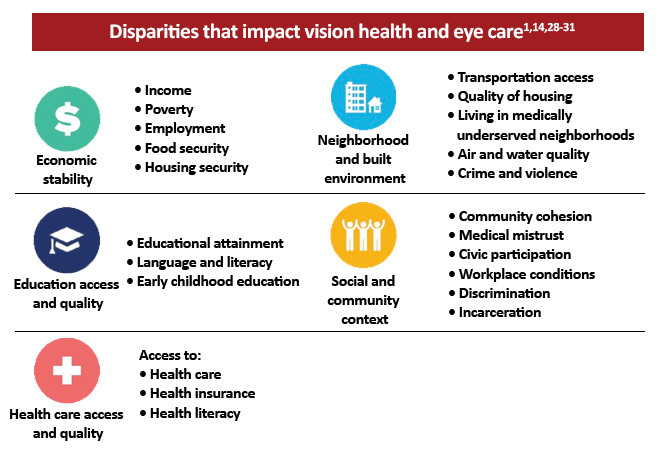
Many factors that impact vision outcomes fall under the umbrella of social determinants of health, defined by the US Department of Health and Human Services as “conditions in the environments where people are born, live, learn, work, play, worship, and age that affect a wide range of health, functioning, and quality-of-life outcomes and risks.” 3
Social determinants of health are grouped under five categories: Economic Stability, Education Access and Quality, Healthcare Access and Quality, Neighborhood and Built Environment, and Social and Community Context. Within eyecare, several prominent social determinants of health can contribute to the prevalence of eye disease including:3
Offering solutions to improve ocular disease prevention and outcomes
Recognizing a greater need to assist population groups that are more vulnerable to certain ocular diseases, the field of ophthalmology as a whole is making efforts toward improvement. Here are some of the changes underway on the organizational, practice, and individual levels.

The American Academy of Ophthalmology (AAO) has its Task Force on Disparities in Visual Health and Eye Care to address health equity in eyecare. This group will help address social determinants of health and medical care, access to care, and outcomes.33

Including more patients from underrepresented minority groups in clinical trials can give a broader perspective on side effects and outcomes related to certain treatments, and increase access to newer medications.1,34

More eye doctors in “medically underserved areas ” can help reach a broader range of patients who otherwise may not have access to eyecare.35 This approach also gives more patients a stable provider, which can improve adherence to appointments and care.

Awareness of implicit bias could help address perceptions of disrespect or lack of courtesy perceived by some non-White patients.23

Identification of patients with lapses in care can be useful both to encourage these patients to seek more frequent eye care understand their treatment burden, and identify those who may benefit from longer treatment intervals.1,24

Offering culturally competent education using diverse, plain language, and translated materials can help to improve health literacy,36,37 and connecting patients to resource navigation can help patients overcome barriers in child/elder care, transportation, and costs.23,36,37

Reducing the burden of frequent injections and monitoring directly addresses the barriers of transportation, cost, and treatment fatigue. This can be achieved by offering personalized treatment regimens and prioritizing next-generation anti-VEGF agents and port delivery systems that extend treatment intervals.1,38

Active outreach, with reminders regarding health appointments and help with scheduling follow-up, are effective ways to ensure that patients maintain eye appointments.36,37
Differences in ocular disease prevalence and outcomes vary widely and encompass encompass many factors. Improving education, addressing social determinants of health, and acknowledging the effects of discrimination and bias on eye care serve as ways to improve equity for all patients.
References
- Elam AR, Tseng VL, Rodriguez TM, et al. Disparities in Vision Health and Eye Care. Ophthalmology. 2022;129:e89-e113. https://www.aaojournal.org/article/S0161-6420(22)00528-0/fulltext
- CDC. Advancing Health Equity: Social Determinants and Vision Loss. Vision and Eye Health. Published March 18, 2025. https://www.cdc.gov/vision-health/health-equity/index.html
- Social Determinants of Health Literature Summaries – Healthy People 2030 | odphp.health.gov. https://odphp.health.gov/healthypeople/priority-areas/social-determinants-health/literature-summaries
- Gender and health equity will only come with universal access to eye health – here’s why. https://www.gavi.org/vaccineswork/gender-and-health-equity-will-only-come-universal-access-eye-health-heres-why
- Dai X, Khan MJ, Sabit A, et al. Association between sociodemographic factors and visual impairment at initial presentation: A SOURCE data repository analysis. AJO Int. 2026;3:100210. https://www.sciencedirect.com/science/article/pii/S2950253525001145
- Siegfried CJ, Shui YB. Racial Disparities in Glaucoma: From Epidemiology to Pathophysiology. Mo Med. 2022;119:49-54. https://pmc.ncbi.nlm.nih.gov/articles/PMC9312450/
- Acuff K, Radha Saseendrakumar B, Wu JH, et al. Racial, Ethnic, and Socioeconomic Disparities in Glaucoma Onset and Severity in a Diverse Nationwide Cohort in the United States. J Glaucoma. 2023;32:792. https://journals.lww.com/glaucomajournal/abstract/2023/09000/racial,_ethnic,_and_socioeconomic_disparities_in.12.aspx
- Lundeen EA, Burke-Conte Z, Rein DB, et al. Prevalence of Diabetic Retinopathy in the US in 2021. JAMA Ophthalmol. 2023;141:747-754. https://jamanetwork.com/journals/jamaophthalmology/fullarticle/2806093
- Nguyen AH, Davoudi S, Dong K, et al. Socioeconomic Disparities in Patients Receiving Intravitreal Injections for Age-Related Macular Degeneration Amid the COVID-19 Pandemic. J Vitreoretin Dis. 2023;7:376-381. https://journals.sagepub.com/doi/10.1177/24741264231173771
- Chandra S, Sommi A, Rasendran C, et al. Racial Disparities in Anti-VEGF Treatment for Neovascular AMD Influenced by Social Determinants of Health. Invest Ophthalmol Vis Sci. 2025;66:3076.
- Acharya B, Momenaei B, Zhang Q, et al. Disparities in presentation and anti–VEGF therapy initiation for neovascular age-related macular degeneration: an analysis of the academy IRIS® registry. Ophthalmology. 2025;0.
- Uhr JH, Chawla H, Williams BK, et al. Racial and Socioeconomic Disparities in Visual Impairment in the United States. Ophthalmology. 2021;128:1102-1104. https://www.aaojournal.org/article/S0161-6420(20)31044-7/abstract
- Palia R, Qin SL, Pruett JK, et al.How social determinants of health shape outcomes in retinal disease. Retina Specialist. December 23, 2025. https://www.gavi.org/vaccineswork/gender-and-health-equity-will-only-come-universal-access-eye-health-heres-why
- Haller JA, Tomaiuolo M, Lucas MM, et al. Disparities in Retinal Vein Occlusion Presentation and Initiation of Anti-VEGF Therapy: An00- Academy IRIS® Registry Analysis. Ophthalmol Retina. 2024;8:657-665. https://www.ophthalmologyretina.org/article/S2468-6530(24)00043-5/abstract
- Burkat CN, Deyabat OA, Ibrahim S, et al. Social determinants of health: ophthalmic implications. EyeWiki – American Academy of Ophthalmology. Published August 28, 2023. https://eyewiki.org/Social_Determinants_of_Health:_Ophthalmic_Implications#Common_Eye_Diseases_and_Visual_Outcome_Disparities
- Zafar S, Walder A, Virani S, et al. Systemic Adverse Events Among Patients With Diabetes Treated With Intravitreal Anti–Vascular Endothelial Growth Factor Injections. JAMA Ophthalmol. 2023;141:658-666. https://jamanetwork.com/journals/jamaophthalmology/fullarticle/2805503
- Ciociola EC, Sekimitsu S, Smith S, et al. Racial Disparities in Glaucoma Vision Outcomes and Eye Care Utilization: An IRIS Registry Analysis. Am J Ophthalmol. 2024;264:194-204. https://www.sciencedirect.com/science/article/pii/S0002939424001260
- Anozie CC, Cox VF, Wiseman MT, et al. Racial and Ethnic Disparities in Risk for Adverse Ocular Events in Patients With Diabetic Retinopathy. Am J Ophthalmol. 2026;282:316-337. https://www.ajo.com/article/S0002-9394(25)00593-8/abstract
- Gao X, Obeid A, Aderman CM, et al. Loss to Follow-up After Intravitreal Anti–Vascular Endothelial Growth Factor Injections in Patients with Diabetic Macular Edema. Ophthalmol Retina. 2019;3:230-236. https://www.sciencedirect.com/science/article/pii/S2468653018304354
- Okada M, Mitchell P, Finger RP, et al. Nonadherence or Nonpersistence to Intravitreal Injection Therapy for Neovascular Age-Related Macular Degeneration: A Mixed-Methods Systematic Review. Ophthalmology. 2021;128:234-247. https://www.aaojournal.org/article/S0161-6420(20)30748-X/abstract
- Jennings E, Geevarghese A, Modi Y. Sociodemographic Variables, Racial Disparity, and OCT-Based Biomarkers as Predictive Factors of DME Refractory to Bevacizumab. Invest Ophthalmol Vis Sci. 2024;65:6243.
- Malhotra NA, Greenlee TE, Iyer AI, et al. Racial, Ethnic, and Insurance-Based Disparities Upon Initiation of Anti–Vascular Endothelial Growth Factor Therapy for Diabetic Macular Edema in the US. Ophthalmology. 2021;128:1438-1447. https://www.aaojournal.org/article/S0161-6420(21)00196-2/abstract
- Huang BB, Radha Saseendrakumar B, Delavar A, et al. Racial Disparities in Barriers to Care for Patients With Diabetic Retinopathy in a Nationwide Cohort. Transl Vis Sci Technol. 2023;12:14. https://tvst.arvojournals.org/article.aspx?articleid=2785447
- Cai CX, Li Y, Zeger SL, et al. Social determinants of health impacting adherence to diabetic retinopathy examinations. BMJ Open Diabetes Res Care. 2021;9. https://drc.bmj.com/content/9/1/e002374
- Burmeister J, Pham MN, Bohler F, et al. Diabetic retinopathy in rural communities: a review of barriers to access of care and potential solutions. Ann Med. 57:2522323. https://pmc.ncbi.nlm.nih.gov/articles/PMC12231324/
- Cardona M, Alwenya K, Rehman A ur, et al. Eye care interventions that reduce access inequities for women, rural residents and older people in low-middle-income countries: a scoping review. Front Public Health. 2025;13. https://www.frontiersin.org/journals/public-health/articles/10.3389/fpubh.2025.1578848/full
- Review of Optometry. Geographic Location, Perceived Health Status Associated with Visual Impairment. https://www.reviewofoptometry.com/article/geographic-location-perceived-health-status-associated-with-visual-impairment
- Tran MT, Gonzalez VV, Mead-Harvey C, et al. Insights into eye care accessibility: geospatial distribution of eye care providers and socioeconomic factors by ZIP code. Transl Vis Sci Technol. 2024;13:21. https://pmc.ncbi.nlm.nih.gov/articles/PMC10981161/
- Elam AR, Lee PP. Barriers to and Suggestions on Improving Utilization of Eye Care in High-Risk Individuals: Focus Group Results. Int Sch Res Not. 2014;2014:527831. https://pmc.ncbi.nlm.nih.gov/articles/PMC4897391/
- McDermott IV JJ, Lee T, Chan A, et al. Assessing risk factors for retinal vein occlusions using the NIH All of Us Research Program. Invest Ophthalmol Vis Sci. 2021;62:176.
- Woldetensaye AG, Selander JM, Huang H, et al. The Impact of Social Determinants of Health on Presentation, Treatment, and Outcomes in Branch Retinal Vein Occlusion With Cystoid Macular Edema. Ophthalmic Surg Lasers Imaging Retina. 2023;54:411-416. https://journals.healio.com/doi/abs/10.3928/23258160-20230616-01
- Barthelemy N, Tailor P, Sridhar J, et al. Effects of socioeconomic factors on visual outcome and management of wet age-related macular degeneration patients. RETINA. Published online May 12, 2022:10.1097/IAE.0000000000004649. https://journals.lww.com/retinajournal/abstract/9900/effects_of_socioeconomic_factors_on_visual_outcome.1178.aspx
- American Academy of Ophthalmology. Meeting the needs of all our patients. https://www.aao.org/meeting-needs-of-all-patients
- US Food and Drug Administration. Center for Drug Evaluation and Research. Enhancing participation in clinical trials — eligibility criteria, enrollment practices, and trial designs. Published December 15, 2025. https://www.fda.gov/regulatory-information/search-fda-guidance-documents/enhancing-participation-clinical-trials-eligibility-criteria-enrollment-practices-and-trial-designs
- Solomon SD, Shoge RY, Ervin AM, et al. Improving Access to Eye Care: A Systematic Review of the Literature. Ophthalmology. 2022;129:e114-e126. https://www.aaojournal.org/article/S0161-6420(22)00530-9/fulltext
- Huang RS, Naidu SC, Mihalache A, et al. Loss to Follow-Up in Patients With Proliferative Diabetic Retinopathy or Diabetic Macular Edema. JAMA Netw Open. 2024;7:e2450942. https://jamanetwork.com/journals/jamanetworkopen/fullarticle/2828027
- Khurana RN, Li C, Lum F. Loss to Follow-up in Patients with Neovascular Age-Related Macular Degeneration Treated with Anti–VEGF Therapy in the United States in the IRIS® Registry. Ophthalmology. 2023;130:672-683. https://www.aaojournal.org/article/S0161-6420(23)00132-X/fulltext
- Almony A. Disease Burden of Neovascular Age-Related Macular Degeneration and Diabetic Macular Edema. Am J Manag Care. 2023;29:S75-S80. https://www.ajmc.com/view/disease-burden-of-neovascular-age-related-macular-degeneration-and-diabetic-macular-edema
All URLs accessed December 24, 2026.